![[Staging] Aiisa](https://aiisa.hajagency.com/wp-content/uploads/2026/02/aiisa-logo.svg)

Introduction
Some media outlets have recently published material claiming that it is impossible to predict the market. If they mean 100% accuracy, we agree. However, we want to offer a more nuanced perspective. With real AI, it is now possible to forecast the market with a level of accuracy that opens entirely new opportunities for investors.
We decided to ask AIISA how things really stand.
Börsvärlden is the first to receive permission to publish all predictions — including the training period — for the model AIISA_ITrade 1.0.
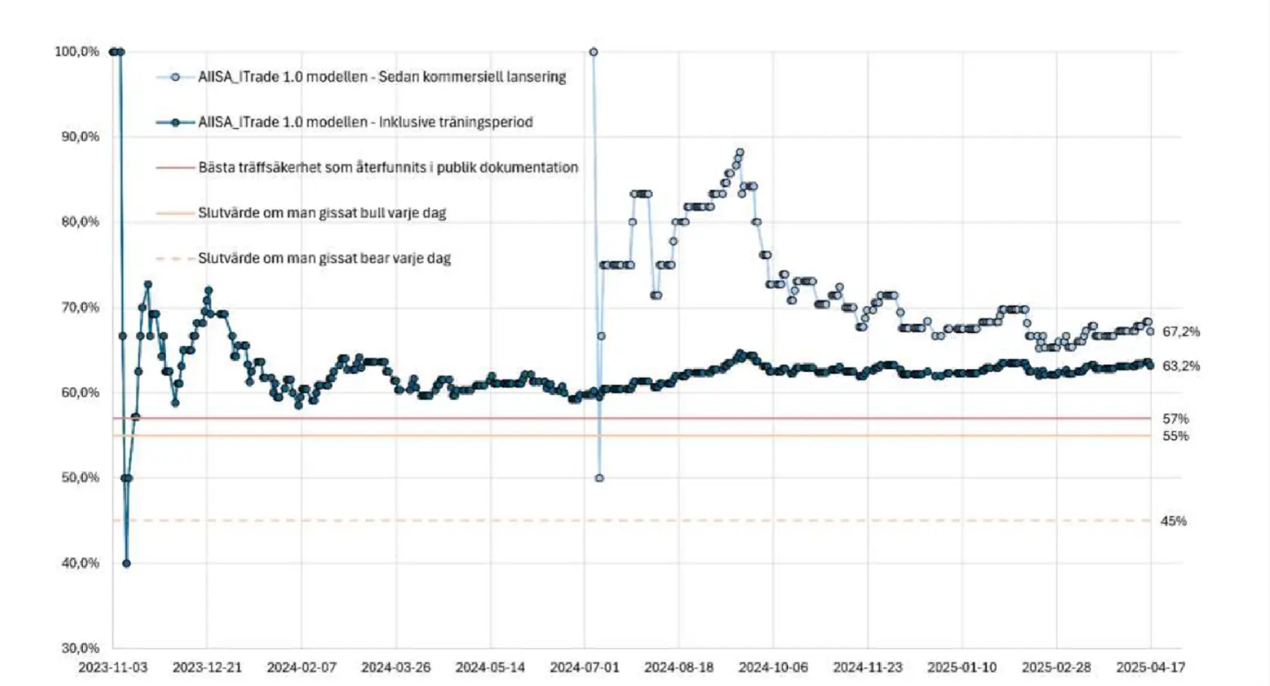
AIISA AB is the Swedish AI company from Gothenburg that developed the model. Börsvärlden has been given open access to the data behind Aiisa’s predictions of whether the Stockholm Stock Exchange index will close higher or lower than the previous day. Data has been available since November 3, 2023, and the results are published above.
The conclusion is that Aiisa can predict market movements in advance with an accumulated accuracy of approximately 64%, including the training period, evaluated from November 3, 2023, to April 17, 2025. If we look at accumulated accuracy since the commercial launch on July 6, 2024 — meaning the model is allowed to benefit from training since 2023‑11‑03 — the accuracy reaches 67.2% as of April 17, 2025.
Has it been an easy market to predict?
In autumn 2023, the war between Israel and Hamas breaks out. High interest rates persist toward the end of the year, and inflation begins to fall.
During 2024, we have the U.S. presidential election, falling interest rates, and declining inflation. Sweden also sees decreasing energy prices.
In 2025, Trump’s aggressive tariff policies hit companies and markets around the world, resulting in extreme market volatility.
On top of this, we have events related to the war in Ukraine.
So yes — Aiisa has been forced to account for many sudden shifts and new information with no historical precedent. “It has truly been a challenging market to predict,” says Martin Kwasniewski, founder of AIISA AB and creator of Aiisa.
AIISA has searched publicly available documentation and spoken with representatives from, among others, Nordea and SEB. “No one can confirm the existence of any known index prediction model that delivers what AIISA delivers today,” Martin says.
To forecast movements on the Stockholm Stock Exchange and provide investment ideas to its users, Aiisa uses trading data and media sources.
Aren’t you worried that this is easy to copy? Doesn’t everyone have access to the same data?
Yes, but many attempt to solve the problem using traditional machine learning or technical analysis. That is likely one of the reasons they have not succeeded over time. Much of the data Aiisa uses has been generated by Aiisa itself over many years and is processed using proprietary mathematical relationships rooted in complex systems dynamics, evolutionary theory, and quantum physics.
“But don’t you use neural networks?” is a question we hear almost every time. Many people — without deeper knowledge of the field — associate cutting‑edge AI with neural networks. “I built my first neural network in the 1990s. A lot has happened since then, and today’s leading AI models are far more sophisticated than what the mathematics behind neural networks alone can offer.”
There are correlations out there showing co‑movement between markets, trading data, and even non‑financial variables. How do you respond to criticism that such relationships are easy to find?
Correlation is one thing; predictive power and causality are another. The stock market is a complex system with chaotic properties, and this must be accounted for to create predictions that work over time. It is not enough that correlations exist between one or several variables in a dataset.
Another question: If we look at the balance between bull and bear days, is there any bias? How does this affect the conclusion that the market can be predicted at the level discussed earlier?
During the measurement period, OMXSPI had 45% down days and 55% up days (November 3, 2023 – April 17, 2025). Let’s do a simplified thought experiment: If we had simply guessed that the market would close higher every day, we would have achieved about 55% accuracy — and about 45% if we had always guessed lower.
Since we continuously predict both up and down days with a combined accuracy above this interval, we can confidently conclude that Aiisa has truly learned how Nasdaq Stockholm behaves — to the extent that she has successfully predicted direction on the days she chooses to issue an investment idea, with at least 64% correct predictions, Martin says.
When does Aiisa deliver its prediction?
Currently, the prediction is delivered at 08:25 each morning before the market opens. With more computing power, the forecast could be delivered much earlier.
Could it even be delivered before the market closes the day before? “Yes, absolutely.”
But the market moves throughout the day. What if Aiisa predicts an up‑day, but the market opens very high? It could fall intraday yet still close above the previous day — meaning Aiisa is correct, but I lose money if I buy at the open?
We can already mathematically show that if you buy at the open and sell at the close on days where Aiisa issues an investment idea with a probability level between 68.4% and 78.5%, and you use a stop‑loss at –0.56% and a take‑profit at +1.51%, the strategy would theoretically have generated profit. These levels are updated daily by Aiisa.
Daily intraday trading support for both humans and machines is something we are actively developing and hope to launch in stages soon.
For now, users of the app or API must incorporate Aiisa’s bull or bear prediction into their own intraday analysis.
However, this is only the beginning, Martin says. We have a beta release of the AIISA_ITrade model that will also provide users with a forecast of the coming intraday pattern between 09:00 and 17:30 — in relatively high resolution. It is intended to be available before the market opens each day and will be launched via API as well as in a graphical version for app users, including suggested advantageous entry points during the day. “We continuously work to ensure Aiisa’s customers stay one step ahead of the market,” Martin continues.
What happens if everyone trades on these signals?
Since there are many ways to use the information, we do not see a direct problem. We also do not give everyone the exact same timestamp for when to enter the market. Combined with the different scales of capital, varying instruments, and diverse order types, we are not concerned.
As always in markets: with enough capital, you can create imbalance — but that applies to most assets, Martin says.
Is it more risky to trade index than individual stocks on a daily basis?
“No, not in my view. Index futures are among the most liquid instruments available. Individual stocks — especially on small cap — may be harder to sell during sudden market moves, particularly in larger volumes. When using Aiisa’s investment ideas for index, you are also not continuously exposed, which further reduces risk. However, you must consider your portfolio risk — meaning the percentage of capital allocated to different assets. That is a matter of proper portfolio construction.”
How is the search for more B2B partnerships going?
Interest is growing. We have now signed another B2B agreement with the AI company Talk to Data, which will join Aiisa’s platform this year. Users will be able to ask questions in a chat about quarterly and annual reports for companies listed on Nasdaq Stockholm and have this integrated and visualized together with Aiisa’s market forecasts.
“With AIISA, we show that our technology belongs not only in academia. What began as a tool for analyzing research papers at record speed is now becoming a powerful resource for investors who want to understand company reports in depth,” says Talk to Data’s CEO, Konrad Claesson.
Summary
Recent discussions in the media claim that the stock market cannot be predicted. If the expectation is 100% accuracy, that’s true — but the full picture is more nuanced. With advanced, domain‑specific AI, it is now possible to forecast market direction with a level of precision that creates real value for investors.
AIISA’s model, AIISA_ITrade 1.0, has been independently reviewed by Börsvärlden, which examined all predictions dating back to November 2023. The results show an accumulated accuracy of around 64%, and 67.2% since the model’s commercial launch in July 2024 — achieved during one of the most volatile periods in recent years.
Aiisa’s approach goes far beyond traditional machine learning or simple correlations. The model uses proprietary data and advanced mathematical methods inspired by complex systems dynamics, evolutionary theory, and quantum physics. This enables Aiisa to understand the chaotic behavior of financial markets and generate predictions that hold up over time.
Aiisa delivers daily forecasts on whether the Stockholm market will close higher or lower, and the company is now expanding into intraday predictions and automated trading support. Interest from institutional partners is growing as well, including a new collaboration with Talk to Data, which integrates company‑report analysis with Aiisa’s market forecasts.
The conclusion: real AI can predict market movements with meaningful accuracy, giving investors a powerful new tool to stay ahead of the market.